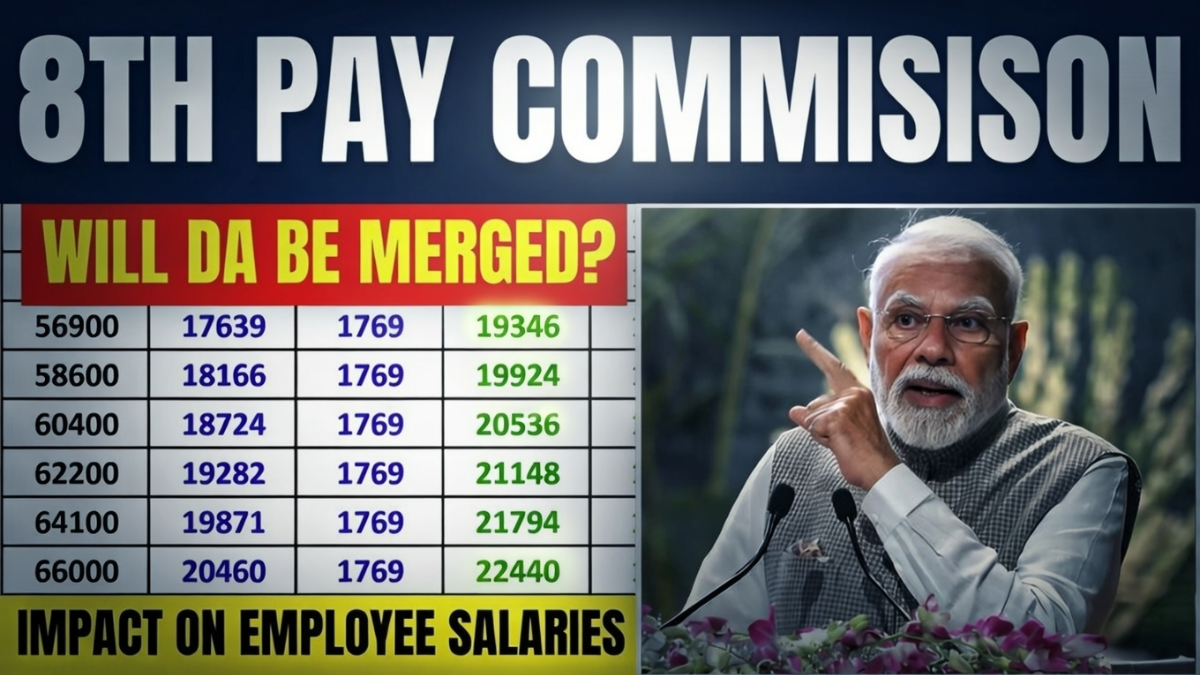
The 8th Pay Commission 2026 update has once again become a major talking point among central government employees and pensioners across the country. Rising inflation, continuous Dearness Allowance hikes, and long-pending demands from employee unions have revived discussions around a possible DA merger with basic pay. If this proposal moves forward, it could result in a substantial increase in monthly salary, pension amount, and long-term retirement benefits.
Although there is no official notification yet, the expectations surrounding the 8th Pay Commission and DA merger are growing rapidly. Here is a complete, clear, and detailed breakdown of what the update means, why it matters, and what employees should realistically expect in 2026.
What Is the 8th Pay Commission and Why 2026 Is Crucial
The Pay Commission is a central government-appointed body that reviews and recommends changes to the salary structure, allowances, and pensions of government employees. The 7th Pay Commission was implemented in 2016, and historically, a new pay commission is formed roughly every ten years.
With 2026 approaching, employees believe the government may begin preparations for the 8th Pay Commission. This timing is important because inflation-linked Dearness Allowance has already crossed significant levels, raising concerns about salary sustainability under the existing pay matrix.
A new pay commission generally brings changes in basic pay calculation, fitment factor, pay matrix restructuring, and pension revision. This is why even early discussions around the 8th Pay Commission generate widespread interest.
Understanding DA Merger and Why It Matters So Much
Dearness Allowance is provided to government employees and pensioners to offset the impact of inflation. It is revised twice a year based on the All India Consumer Price Index data.
Over time, DA keeps increasing and becomes a large component of total salary. In previous pay commission cycles, when DA crossed certain thresholds, it was merged into basic pay to reset the salary structure. This process is known as DA merger.
When DA is merged with basic pay, the basic salary increases permanently. This is important because many allowances and benefits are calculated on basic pay, not on DA.
How DA Merger Can Directly Increase Salary
If DA merger is approved under the 8th Pay Commission framework, the immediate effect will be a higher basic pay. Since House Rent Allowance, Transport Allowance, and future Dearness Allowance are calculated on basic pay, the overall monthly salary increases automatically.
This also creates a compounding effect. Every future DA hike will be applied to the revised higher basic pay, leading to continuous long-term gains instead of temporary inflation relief.
For serving employees, this means higher take-home salary and stronger financial stability against rising living costs.
Pensioners to Gain Permanent Benefits From DA Merger
Pensioners are expected to be among the biggest beneficiaries if DA merger happens. Pension is calculated as a percentage of the last drawn basic pay. Once the basic pay increases due to DA merger, the pension amount also increases permanently.
Unlike DA hikes, which fluctuate with inflation, a higher basic pension provides long-term financial security. It also positively impacts family pension, commutation value, and dearness relief calculations for retired employees.
For many pensioners facing rising medical and household expenses, this change could bring meaningful relief.
Impact on Retirement Benefits and Other Allowances
The impact of DA merger goes beyond monthly salary and pension. Retirement benefits such as gratuity, leave encashment, and commutation value are closely linked to basic pay.
With a higher basic pay, employees retiring after the implementation of the 8th Pay Commission could receive significantly higher lump-sum benefits. This is one of the reasons employee unions strongly push for DA merger during pay commission revisions.
Additionally, allowances that depend on basic pay will also see an automatic increase without the need for separate policy changes.
Current Official Status of the 8th Pay Commission 2026
At present, there is no official announcement confirming the formation of the 8th Pay Commission or approval of DA merger. The central government has not issued any notification regarding the terms of reference or timelines.
However, growing inflation pressure, repeated union representations, and past pay commission patterns suggest that discussions may intensify as 2026 approaches. Any final decision will depend on approval from the Government of India and subsequent cabinet clearance.
Until then, DA revisions will continue under the existing 7th Pay Commission framework.
When Can Employees Expect Clarity on DA Merger
If previous pay commission timelines are followed, initial signals or announcements could emerge closer to budget discussions or during major policy reviews. Employee unions are expected to raise the issue more aggressively in the coming months.
It is important for employees and pensioners to rely only on official notifications and avoid misinformation circulating on social media. Any confirmed update will be communicated through government channels.
Why Expectations Are High Despite No Confirmation
Expectations around the 8th Pay Commission and DA merger are high because inflation levels have significantly reduced the real value of salaries over the years. DA hikes help, but they do not permanently improve income structure.
A DA merger offers a structural correction rather than temporary relief. This is why employees view it as a necessary step rather than a bonus.
Conclusion
The 8th Pay Commission 2026 update related to DA merger has the potential to bring a major transformation in salaries and pensions for central government employees and pensioners. While there is no official confirmation yet, the logic behind DA merger, past pay commission trends, and rising inflation make this discussion highly relevant.
If approved, the move could permanently increase basic pay, boost pensions, enhance retirement benefits, and improve long-term financial security. Until an official announcement is made, employees should stay informed and patient while tracking credible government updates.
Disclaimer: This article is based on current discussions and publicly available information. Final decisions will depend on official government notifications and policy approvals.